
The gap between what you want to build and what planning rules allow is where most garden room projects run into trouble. Not because the rules are harsh, but because they are specific, and the details are easy to overlook until they become a problem.
At Eden Landscapes, we have been talking through garden room planning restrictions with homeowners across Cardiff and the Vale of Glamorgan since our Wenvoe show site opened in 2014. This guide sets out the things worth knowing before you commit.
What permitted development actually grants you
Permitted development rights are a standing grant of planning permission from the Welsh Government. They let certain building work go ahead without a formal planning application, provided every condition in the rules is met simultaneously. Not most of them. All of them.
For garden rooms in Wales, the relevant conditions are set out in the Welsh Government’s guidance on outbuildings. They apply to houses only, not flats or maisonettes. The core requirements are that the building is single-storey, sits in the rear or side garden, stays within defined height limits, keeps total built coverage on the plot below 50 per cent, and is used for something incidental to the main house rather than as independent accommodation.
Every condition carries equal weight. A building that meets five out of six is not permitted development.
The height rules, and why roof shape matters
Height is the restriction that most commonly shapes a design, particularly for gardens where the room will sit close to a fence or boundary.
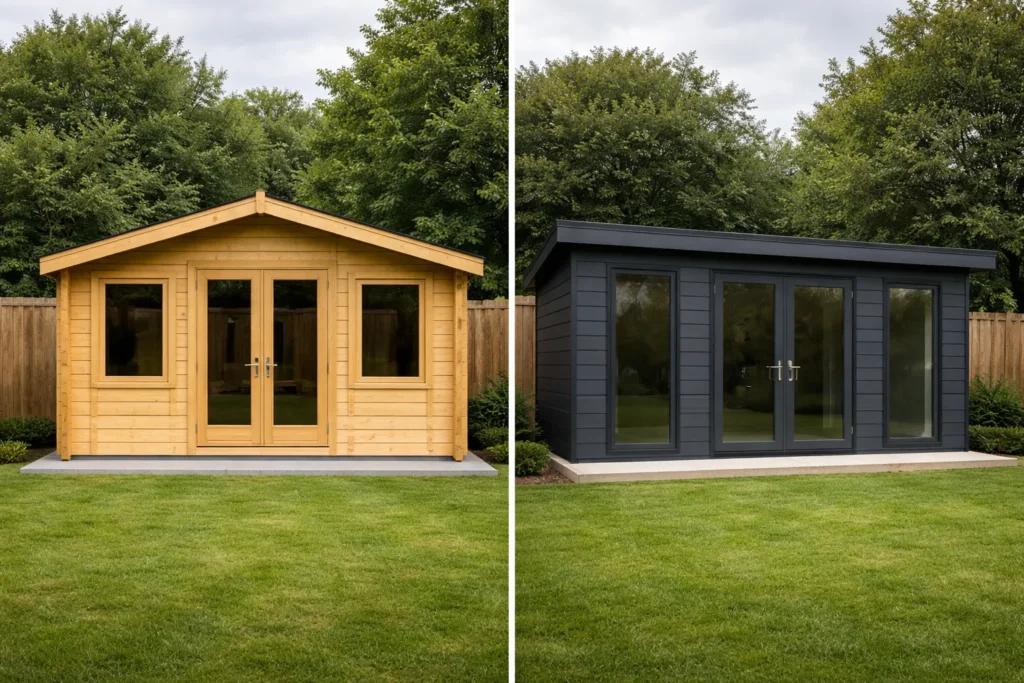
Where the garden room sits more than 2 metres from any boundary, the limits are:
| Roof type | Maximum overall height | Maximum eaves height |
| Dual-pitched (apex) | 4 metres | 2.5 metres |
| Any other roof style | 3 metres | 2.5 metres |
Where the building comes within 2 metres of any boundary, the overall height limit drops to 2.5 metres regardless of roof style. That figure is measured from the base of the structure, so a raised timber deck or concrete plinth adds to the total. It is a detail that catches a surprising number of projects after they have already been ordered.
The practical implication is that an apex roof is not always the right choice. For plots where the building will sit close to a fence, a pent or flat roof may be the only option that keeps the structure within permitted development.
Position: where in the garden it can go
A garden room must not be built forward of the principal elevation of the house. For a standard semi-detached or terraced property, the rear garden is usually fine. Corner plots and properties where the front door does not face the road can make this harder to judge, and confirming the position with your local authority before ordering is always sensible.
In conservation areas, National Parks, and Areas of Outstanding Natural Beauty, there is an additional restriction that applies specifically in Wales: no new development is permitted on land between the side elevation of the house and the side boundary of the plot. That removes the side return as an option in those locations. It is particularly relevant for Eden customers in Penarth, the coastal parts of the Vale of Glamorgan, and other areas that fall within or close to designated land.
Site coverage: the calculation most people get wrong
The 50 per cent coverage rule refers to the land around the original house at the time it was first built, not the current garden size. Every structure added since that original build counts: extensions, conservatories, sheds, garages, greenhouses, and any previous outbuildings.
The Planning Portal’s outbuildings guidance makes clear that this calculation is cumulative and that all additions to the original house are included, not just the outbuildings themselves. In practice, a garden that feels spacious can have significantly less permitted development headroom than it appears once the existing footprint is added up properly.
Our Farnham 2024 installation is a useful illustration. Before placing the order on that 5.4m x 3m Lugarde building, John and Jamie worked through the site coverage calculation with the client’s contractors to confirm the position was correct. Getting those checks done before an order is placed is the step most suppliers skip.
Uses that require planning permission regardless of dimensions
A building that sits perfectly within every dimensional rule can still require planning permission if the intended use does not qualify as incidental to the enjoyment of the house.
Permitted uses under permitted development include home working, hobbies, creative practice, exercise, reading, relaxing, and household overflow storage. These activities all support life in the main house without turning the garden room into an independent unit.
What takes a building outside permitted development is any use that creates self-contained accommodation: a guest bedroom with its own shower room, a space with a kitchen, bathroom, and separate entry that could function independently of the main house. The UK Government’s technical guidance on permitted development rights is explicit that separate self-contained living accommodation does not fall within the standard outbuilding rules, regardless of how the building looks or how it is marketed.
A home office is fine. A studio used for personal creative work is fine. A reflexology space used by the household for their own practice is fine, as one of our clients in South Wales confirmed when their Lugarde pod was installed for exactly that purpose. The line is drawn at a building that could operate as a separate household.
Four situations where permitted development does not apply at all
Listed buildings. Planning permission is required for any outbuilding within the curtilage of a listed building. The listing applies to the entire plot, not just the main house, and there is no minimum size threshold below which this relaxes.
Article 4 directions. Local planning authorities can remove permitted development rights in specific areas using an Article 4 direction. They are most common in conservation areas, but can be applied anywhere the council identifies a need to manage development more closely. Your solicitor should have flagged any Article 4 direction at purchase, but checking with your local authority directly remains the safest step before proceeding.
National Parks and Areas of Outstanding Natural Beauty. Any outbuilding placed more than 20 metres from any wall of the original house must not exceed 10 square metres in ground coverage. This is a meaningful restriction for anyone with a large garden in an affected area: the 10 square metre limit is considerably smaller than most garden room footprints.
Flats and maisonettes. Permitted development rights for garden room outbuildings apply to houses only. A full planning application is required for any outbuilding on a flat or maisonette property.
Planning permission and building regulations are not the same thing
Satisfying planning rules does not mean that building regulations do not apply. They are two separate frameworks covering two different questions.
Planning permission addresses whether the garden room can be built in principle. Building regulations address how it must be built, covering structure, fire safety, electrics, drainage, and insulation. Most garden rooms under 15 square metres with no sleeping accommodation are exempt from building regulations approval. Between 15 and 30 square metres, approval is not normally required provided there is no sleeping accommodation, and the building is at least 1 metre from any boundary or made substantially from non-combustible materials.
Specific installations, including full electrical fit-outs and plumbing, are still subject to their own compliance requirements regardless of whether the building itself needs building regulations approval.
Choosing a building designed to work within the restrictions
The most consistent mistake we see is choosing a building first and checking the planning position afterwards. The right sequence is the reverse: confirm the site conditions, understand the restrictions that apply, and then choose a building that works within them.
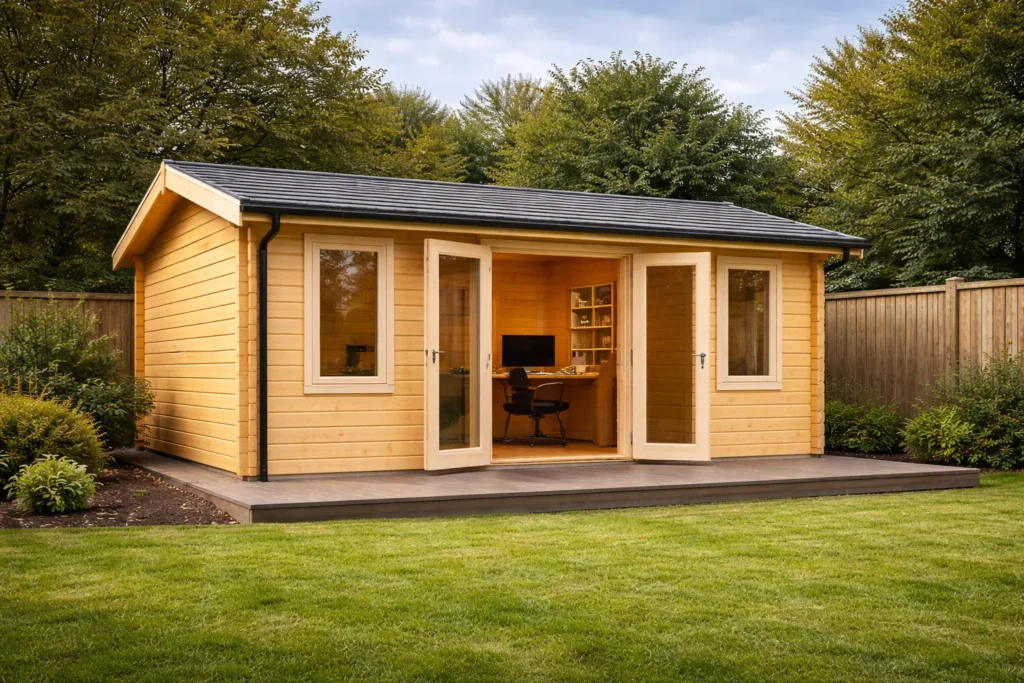
Our Lugarde garden rooms and offices range is available in a wide range of footprints, wall thicknesses, and roof profiles, meaning we can match the specification to the site. The Lugarde Prima System, for instance, uses 28mm or 44mm wall boards and can be configured with pent, apex, or pyramid roof styles, giving real flexibility to stay within height limits without compromising build quality.
If you would like to talk through how the planning restrictions apply to your specific garden, visit us at Pugh’s Garden Village, Wenvoe, Cardiff CF5 6AD, call us on 029 2059 7365, or browse our testimonials and case studies to see how homeowners across the region have navigated the same planning questions in practice.
The key takeaway
Most garden rooms go ahead without a planning application. The restrictions are manageable when they are understood clearly from the start. The projects that run into difficulties are almost always those where a building was chosen before the site conditions were fully checked, not those where the planning position was confirmed first.
If you are still weighing up whether a garden room is the right addition to your property, our guide to the benefits of a garden room sets out how people across South Wales are using them day to day.
This guide covers the general planning rules for garden room outbuildings in Wales. Individual properties may be affected by listed status, conservation area designation, Article 4 directions, existing built coverage, and boundary conditions. Always confirm the specific planning position for your property with your local planning authority before placing an order.