
Planning rules depend on the individual property, its location, and any restrictions affecting it. This article provides general guidance rather than confirmation that a particular development is permitted. If you are unsure, check with your Local Planning Authority before starting work.
If your first shed is already full of garden tools, bikes and outdoor furniture, adding another can seem like the obvious solution. Before choosing where to put it, though, it is worth checking how multiple sheds are treated under UK planning rules.
There is no single UK-wide rule setting a maximum number of sheds you can have. In many cases, you can have more than one garden building without making a planning application.
The number itself is not usually the deciding factor. Size, position, height and use all matter, along with how much of the garden is already occupied by outbuildings and other development.
Planning rules also differ between Wales, England, Scotland and Northern Ireland. As we are based in South Wales, we will focus primarily on Welsh requirements while covering the main differences elsewhere in the UK.
Is There a Legal Limit on How Many Sheds You Can Have?
There is no rule saying every garden can contain only one, two or three sheds.
In Wales, sheds sit within the wider planning category of outbuildings used for purposes incidental to the enjoyment of a home. This can also include garages, greenhouses and other garden structures.
The Welsh Government guidance on outbuildings confirms that these structures can be permitted development when all the relevant conditions are satisfied.
This means a second or third shed may be possible without a planning application. You still need to consider the proposed building alongside the outbuildings already on the property.
It is also important to note that the Welsh permitted development allowances discussed here apply to houses, not flats, maisonettes or other types of building.
How Much of Your Garden Can Sheds Cover?
For homes in Wales, the 50% site-coverage restriction is one of the most important rules to check.
Under Welsh permitted development rules, the total area covered by buildings other than the original dwellinghouse cannot exceed 50% of the curtilage, excluding the ground covered by the original house. Existing and proposed outbuildings, as well as extensions added to the house, can count towards this limit.
Several smaller sheds do not each receive their own separate allowance. Their footprints need to be considered together.
That makes the combined area more important than the number of buildings.
Measure the existing structures and the available garden area before choosing another shed. This is particularly important where a property has been extended or already contains a garage, greenhouse, summerhouse or other substantial garden building.
If the dimensions of an individual structure are your main concern, our guide to the maximum size of a shed without planning permission looks more closely at the restrictions worth checking before you buy.
How High Can a Shed Be Without Planning Permission in Wales?
Height matters too, particularly when a shed is positioned close to the house or a boundary.
Under the general Welsh permitted development limits for outbuildings:
- The building must not exceed one storey
- A building with more than one roof pitch cannot exceed 4 metres in overall height
- A building with a single-pitch or other roof form cannot exceed 3 metres
- A flat-roofed building cannot exceed 2.5 metres
- Eaves cannot exceed 2.5 metres
- Any part within 2 metres of a boundary cannot exceed 2.5 metres in height
- Any part within 2 metres of the house cannot exceed 1.5 metres in height
That final point is particularly easy to overlook. Checking the distance from the garden fence is not enough if the proposed shed will also sit very close to the house.
Look at the full external dimensions of a shed rather than relying on its floor area alone.
Where Can You Put a Second or Third Shed?
A compliant size does not automatically mean every position in the garden will qualify as permitted development.
In Wales, an outbuilding cannot normally be located in front of the building line formed by the principal elevation of the house. There are also restrictions affecting structures extending beyond a side elevation where a highway is involved.
The practical layout of the garden matters as well.
At Eden Landscapes, we opened our garden building and landscaping retail site at Pugh’s Garden Village in Wenvoe in 2014. Having garden buildings displayed alongside landscaping materials highlights an important practical point: the footprint shown on a specification sheet is only part of the space a shed will use.
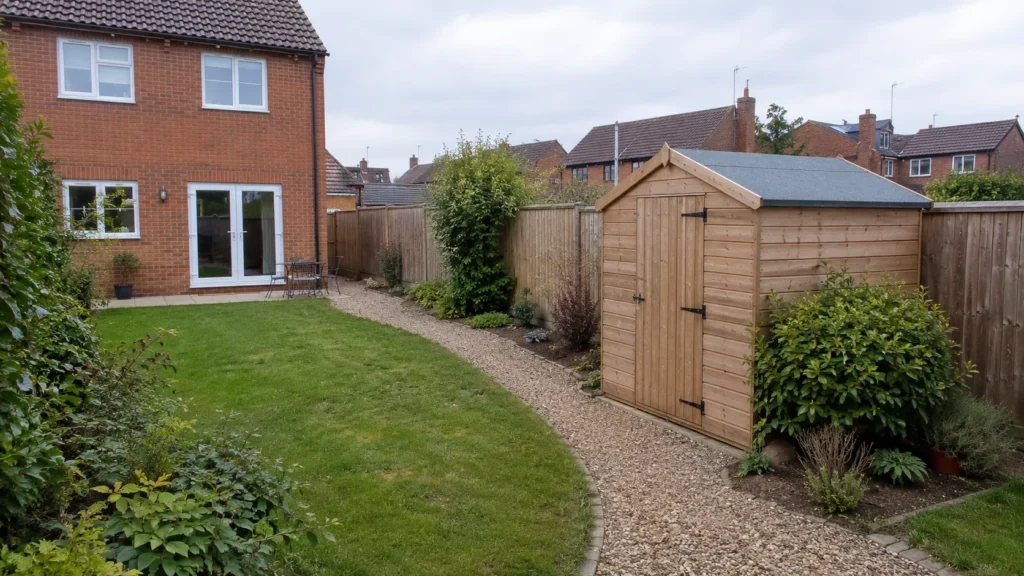
When deciding where another building should go, consider:
- room to open the doors properly
- access for bikes, lawnmowers and larger equipment
- space around the building for maintenance
- drainage around the shed and its base
- views from the house
- effects on natural light
- routes through the garden
- how much useful outdoor space will remain
Several sheds placed close together can leave narrow gaps that are difficult to use or maintain. A little more space around fewer buildings may produce a much more practical garden.
Do Shed Rules Differ Across the UK?
Yes. Planning is devolved, so you should not assume that a shed meeting the rules in Wales will automatically meet the requirements elsewhere.
| Nation | General position |
| Wales | Outbuildings can often qualify as permitted development, subject to coverage, height, siting, use and property-specific restrictions. |
| England | Outbuildings can be permitted development, but no more than half the land around the original house can generally be covered by additions or other buildings. |
| Scotland | At least half of the relevant front or rear curtilage generally needs to remain undeveloped, with separate height and boundary limits. |
| Northern Ireland | Separate permitted development provisions govern coverage, height, siting and use. |
For homes in England, the Planning Portal guidance for outbuildings explains the relevant conditions, including site-coverage and boundary-height rules.
Scotland follows a different system. The Scottish Government’s householder permitted development guidance explains the rules for ancillary buildings such as sheds, garages and greenhouses.
Northern Ireland has its own legislation. The relevant Northern Ireland permitted development rules should be checked if the property is located there.
When Might Another Shed Need Planning Permission?
Even a relatively modest shed can fall outside permitted development rights.
It is worth checking with your Local Planning Authority if:
- Your existing outbuildings already occupy a substantial area.
Adding another shed could take the total footprint beyond the permitted site-coverage limit. - You want to position the building in front of the house.
Permitted development controls where an outbuilding can sit in relation to the principal elevation. - The shed is tall or very close to a boundary.
Different height restrictions apply according to the building’s position. - Your home is listed.
In Wales, planning permission is required for the construction or alteration of outbuildings within the curtilage of a listed building. - The property is within a protected area.
Additional restrictions can apply in locations such as National Parks, Areas of Outstanding Natural Beauty and conservation areas. - Permitted development rights have been removed.
A planning condition or Article 4 direction can restrict development that might otherwise be permitted. - The proposed use is no longer incidental to the home.
A normal garden store is not necessarily treated in the same way as separate residential accommodation or a materially different use.
For protected areas in Wales, further limits can apply depending on the location and position of the proposed outbuilding.
If your property falls into one of these categories, establish the planning position before ordering or installing the building.
Do Building Regulations Apply to Garden Sheds?
Planning permission and Building Regulations are separate systems. Meeting permitted development rules does not automatically settle the Building Regulations position.
According to the current Welsh Government Building Regulations guidance for outbuildings, a detached shed or summerhouse with a floor area below 15 m² will not normally require Building Regulations approval if it contains no sleeping accommodation.
For a detached building between 15 m² and 30 m², approval will not normally be required where there is no sleeping accommodation, and the building is either:
- at least one metre from any boundary, or
- constructed substantially from non-combustible materials.
Larger buildings, sleeping accommodation and more complex projects need to be considered separately.
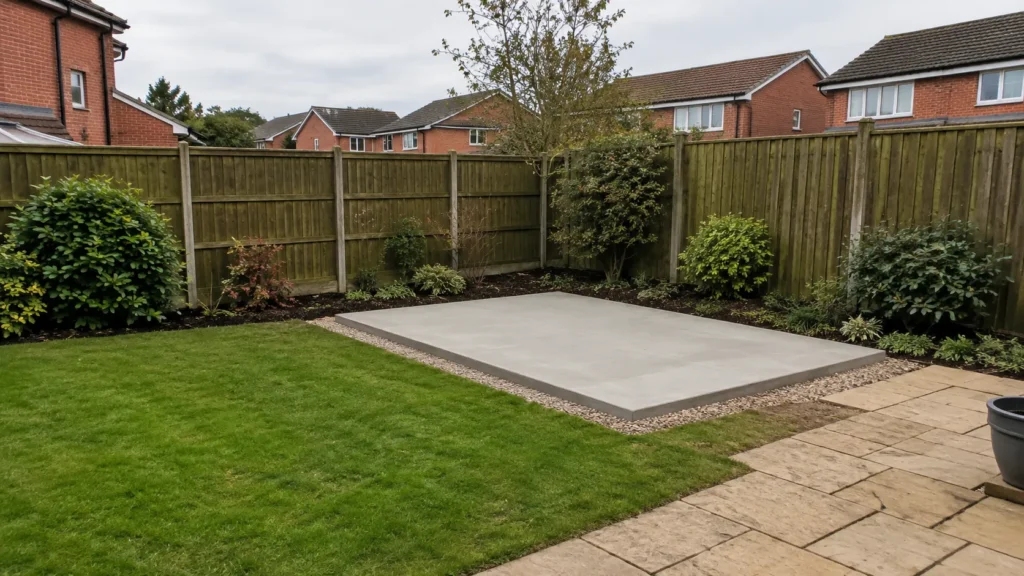
The base deserves proper thought too. A stable and level foundation supports the building correctly and helps avoid problems caused by movement beneath it.
Our guide to foundations for a garden shed covers the main base options and what to consider before installation.
Is It Better to Have Several Small Sheds or One Larger Shed?
It is also worth asking whether another separate building is really the best use of the garden.
Several smaller sheds can work well when they serve genuinely different purposes. You might keep gardening equipment in one and bicycles or DIY tools in another.
However, adding buildings one at a time can gradually reduce the useful space around them. Each shed needs more than its footprint. Doors need clearance, equipment needs room to move, and the structure still needs to be accessible for maintenance.
Before adding another shed, consider:
- what actually needs to be stored
- whether the existing shed could be reorganised
- whether one larger building could replace two smaller ones
- how often you need access to the contents
- how much lawn, patio or planting space will remain
- whether every side of the building can be reached
- how the shed will sit alongside the rest of the garden
If consolidating your storage makes more sense, compare larger footprints rather than automatically adding another small building.
For example, Eden’s Biohort HighLine range is available in multiple sizes, with single or double-door configurations depending on the model. If this type of consolidated storage suits your garden, compare the Biohort HighLine Shed options against the space available before choosing a configuration.
Choosing the Right Number of Sheds for Your Garden
So, how many sheds can you have in my garden? There is no universal number.
You may be able to have several, but the combined development still needs to meet the rules applying to your property. In Wales, total site coverage, building height, location, and proximity to boundaries are among the main considerations.
Check what is already in the garden before ordering another shed. Measure the available area, look at the full dimensions of the proposed building, and establish whether the property is affected by any additional planning restrictions.
If anything is unclear, check with your Local Planning Authority rather than assuming permitted development applies.
The aim is not simply to fit as many buildings into the garden as the rules appear to allow. It is to create enough storage while keeping the outdoor space practical, accessible and enjoyable to use.